
Most gutter-sizing advice online is written for places with steady rain. Colorado Springs is not one of them. Gutters here sit nearly dry from November through February and then take more than half the year's water between June and August, much of it in afternoon bursts. A 5-inch gutter that is adequate for the annual total can still overshoot on a single July afternoon. This article lays out the sourced rainfall figures, explains why peak rate rather than annual total drives gutter size, and lists where 6-inch gutters and larger downspouts earn their cost.
Colorado Springs Gutter Installation is a free quote service. We connect Colorado Springs-area homeowners with independent local gutter installation, guard and repair companies for free, no-obligation quotes. This article is general information, not legal advice.
The numbers: NOAA 1991–2020 normals for Colorado Springs
At Colorado Springs Municipal Airport the annual precipitation normal is 15.91 inches. July (3.12 in.) and August (2.96 in.) are the wettest months, and together they deliver 6.08 inches, about 38 percent of the year's total. Add June (2.27 in.) and the summer season reaches 8.35 inches, 52 percent of the year. May through August accounts for 10.34 inches, about 65 percent; December averages 0.23.
The day counts show how that water arrives. The airport records 36.8 days a year with 0.10 inch or more of precipitation, and 12.8 of them fall in July and August. Only 2.3 days a year reach a full inch. A large share of the annual total comes on a handful of days, and the heaviest are summer thunderstorms rather than all-day rain.
The National Weather Service office in Pueblo describes the season this way: "'Monsoon Season' in Colorado is characterized by slow moving thunderstorms that produce prodigious amounts of lightning, torrential rainfall, and flash flooding," and "July and August are the most active months for Flash Flooding." The common thread in the flash floods it has documented is "sustained (20 minutes or more), 2-3+ inch/hour rain rates." Some years break the pattern entirely: in June 2023 El Paso County recorded its wettest June on record (Colorado State University), the storms carried hail, and PPRBD issued more than 17,000 re-roofing permits that year, up 179 percent on 2022.
Why rate, not total, sizes a gutter
A gutter never sees the annual total. It sees whatever the roof above it is shedding at this moment, and in a two-inch-an-hour storm a steep roof plane sends water to the eave far faster than a day of drizzle would. The gutter has to hold that water long enough to reach a downspout, and the downspout has to swallow it. If either is too small, water sheets over the front lip and lands at the foundation.
That is why the installer's questions matter more than a chart: how big and steep is each roof plane, how long is the run between downspouts, where do valleys concentrate flow, and is the roof metal, which sheds water faster than shingles? A 6-inch K-style gutter is wider and deeper than a 5-inch and is normally paired with 3x4-inch downspouts, which have twice the cross-section of the standard 2x3. The combination moves more water per minute of storm.
When 6-inch gutters pay off
- Large or steep roof planes draining to one eave. Two-story 2000s homes in Wolf Ranch, Meridian Ranch and Monument often have upper roofs that dump onto a lower gutter through a single valley.
- Long runs with few downspouts. If a 50-foot run has one outlet at the far end, water arrives faster than it can leave.
- Metal roofs. Standing-seam roofs in Black Forest and Woodland Park shed water and snow fast; installers usually pair them with 6-inch gutters and snow guards.
- Visible overshoot. A trench in the mulch below the gutter after a July storm, or splash marks on the siding, means the current gutter is already losing.
- Expansive soil and a finished basement. The Colorado Geological Survey maps steeply dipping expansive bedrock across northwest and southwest Colorado Springs, worst within one to three miles of the mountain front. Overshoot there is a foundation problem.
- You are replacing anyway. After hail, when the 5-inch gutters are coming down, the upcharge is only the width difference. The gutter replacement page explains what a replacement quote covers.
Downspouts, extensions and where the water goes
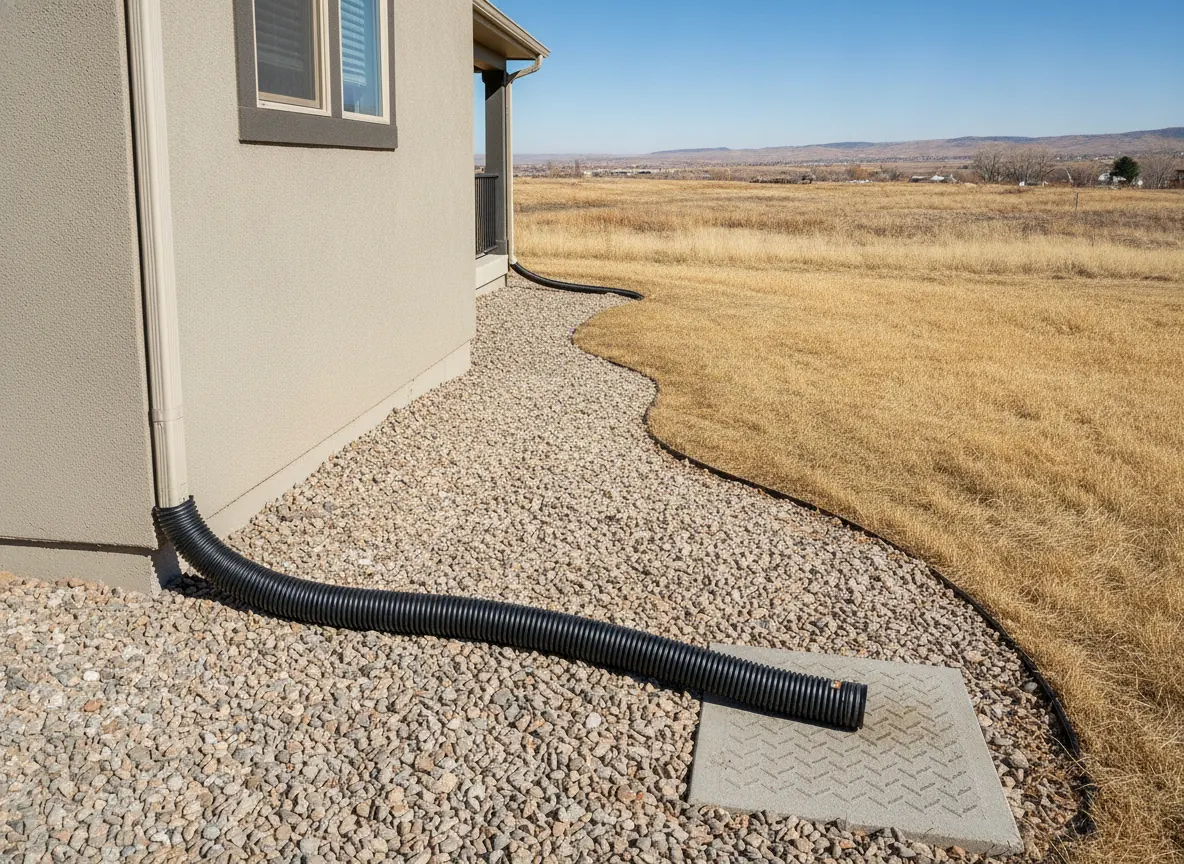
Capacity means nothing if the water lands at the foundation. The Colorado Geological Survey's homeowner guide on swelling soils says water "should be discharged no closer than 5 feet from the foundation" and that a downspout extension is usually necessary; its Colorado Springs engineering report recommends a positive slope of 5 percent in the first ten feet. The 2021 International Residential Code adopted through the 2023 Pikes Peak Regional Building Code calls for grade to fall at least 6 inches in the first 10 feet (R401.3; check PPRBD's amendments before treating it as local law). A HomeAdvisor rule of thumb is one downspout per 35 feet or so of gutter. Downspouts run about $190 each installed (12 ft painted aluminum), or $7–$14 per foot, with extensions $2–$17 each. The downspouts and drainage page and the five-foot rule article go deeper.
What it costs
| Item | Typical range |
|---|---|
| Seamless aluminum gutters, installed, per linear foot | $4–$9 (HomeAdvisor) to $7–$13 (Fixr); Colorado Springs directory $5.80–$10.20 |
| 6-inch instead of 5-inch | about $3–$5 more per ft |
| Whole home, about 200 ft of aluminum | roughly $1,200–$4,200 depending on source and site |
| Downspouts | about $190 each installed (12 ft painted aluminum); $7–$14 per ft; extensions $2–$17 each |
Typical ranges from HomeAdvisor (2026), Fixr (2025) and a Colorado Springs cost directory (2025), estimates, not quotes. On a 200-foot home the 6-inch upgrade works out to roughly $600–$1,000 on top of the base price. Ask each quote to state width, gauge, hanger spacing and downspout count so bids compare on the same scope. The cost guide has the full table and a calculator.
The same storms bring the hail
The thunderstorms that fill gutters in July are the ones that dent them. The July 28, 2016 storm dropped tennis-ball hail on the east side and produced $352.8 million in insurance losses from 84,500 claims (Rocky Mountain Insurance Information Association), which puts the Front Range hail season at mid-April to mid-August. If hail has flattened your 5-inch gutters, replacement is the natural time to go to 6-inch; the hail and roofing-law article explains the paperwork when a roofer is doing both. Ask your insurer what your policy covers.
Frequently asked questions
How much more do 6-inch gutters cost than 5-inch?
About $3 to $5 more per linear foot, according to HomeAdvisor (2026). On a typical 200-foot home that is roughly $600 to $1,000 on top of a 5-inch seamless aluminum price of $4 to $13 per foot, depending on the source. Each extra downspout runs about $190 installed. These are estimates, not quotes.
Do gutter guards work in heavy rain?
Some do and some do not, and a Colorado Springs cloudburst is the test. Fine micro-mesh can shed water over the front edge when a steep roof delivers it fast; screens and reverse-curve covers behave differently again. Ask the installer what rain rate the product was tested at, whether it has been used on a roof pitch like yours, and what happens at inside corners and under valleys, where flow concentrates.
How many downspouts should a house have in Colorado Springs?
A common rule of thumb is one downspout for every 35 feet or so of gutter, and more where a valley or a long upper roof drains into one run. Because the local storms are short and intense, outlet capacity matters as much as gutter width. Ask the quote to list the downspout count and size, and make sure each one discharges at least five feet from the foundation, as the Colorado Geological Survey recommends.
Do I even need gutters with only 16 inches of rain a year?
The annual total is modest, but 6.08 of those 15.91 inches arrive in July and August as thunderstorms. The stronger argument is the soil. The Colorado Geological Survey calls expansive soil Colorado's most significant geologic hazard and says roof downspouts that dump water at the foundation are a common cause of damage, recommending discharge at least five feet out. Gutters and extensions are how that water gets there.
Get a quote before the next monsoon season
Spring and fall are the dry-ground windows for gutter work. A free, no-obligation quote request takes about a minute; mention whether you have seen overshoot and whether you want 5-inch and 6-inch priced side by side. We usually reply the same day. You can also call: Call (727) 300-6656.