
Heat Tape & Ice Dam Prevention in Colorado Springs, CO
We connect homeowners across Colorado Springs, the Palmer Divide and Woodland Park with independent local companies for free, no-obligation quotes on roof and gutter heat cable, snow guards and ice dam prevention. Here is how ice dams form, why the 7,000-foot line matters, self-regulating versus constant-wattage cable, and typical prices.
Get a Free Quote Call (727) 300-6656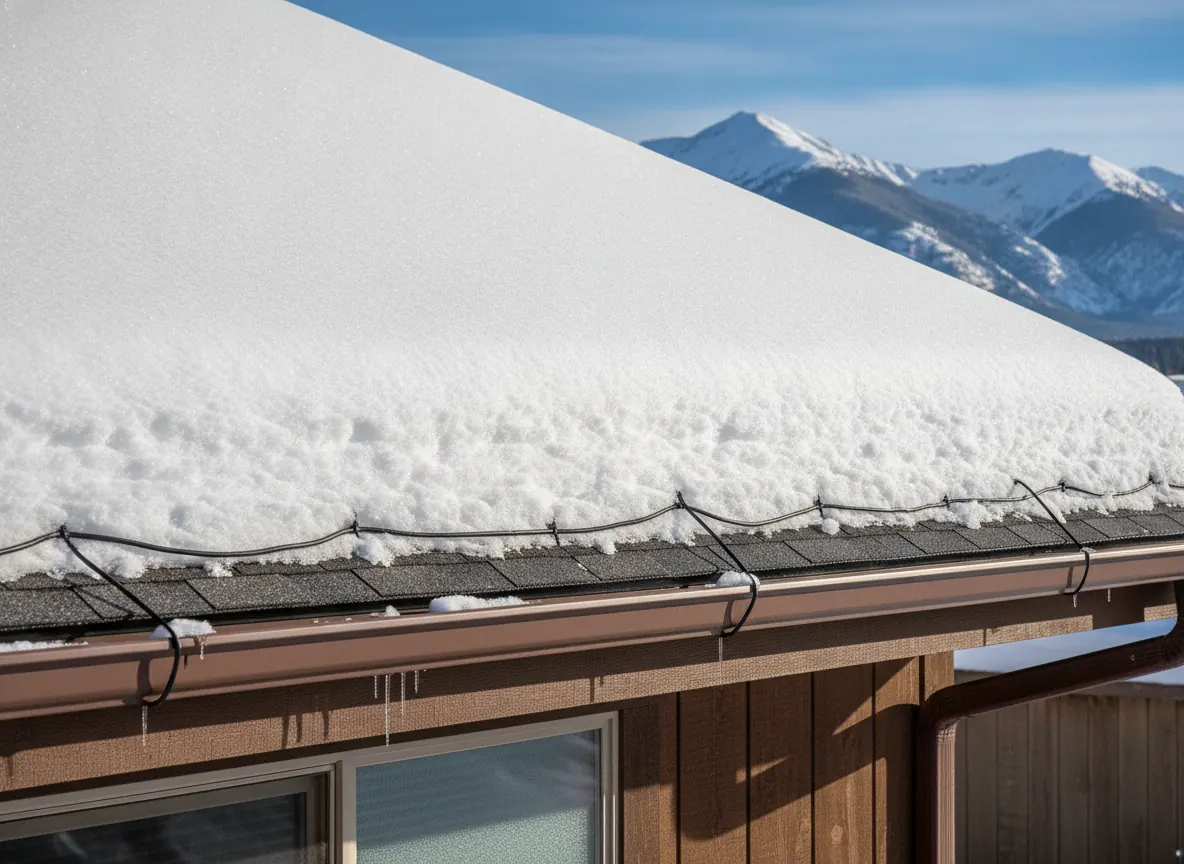
How ice dams form on Front Range roofs
An ice dam is a ridge of ice at the eave. Heat escaping through the roof deck, from a warm attic, recessed lights or a bathroom fan, melts the underside of the snowpack; the water runs down under the snow to the cold overhang past the exterior wall and refreezes. The ridge grows with every cycle, water pools behind it and eventually backs up under the shingles into the wall or ceiling. The gutter, full of ice at the lowest, coldest point, is where the dam anchors.
The airport records 159.7 nights a year at or below 32°F and an average January low of 18.5°F against an average high of 45.0°F (NOAA 1991–2020 normals), so a roof melts in afternoon sun and refreezes at the eave that night. Snow averages 32.5 inches a year at the airport, with March (5.7 in.) and April (5.5 in.) the heaviest months, when it falls wet and heavy and sticks to the roof.
The 7,000-foot line: Monument, Black Forest and Woodland Park
Snow is a different problem north and west of the city. The NOAA station at Monument (elevation about 6,982 feet) records 121.1 inches of snow a year, 3.7 times the airport, with 34.5 days of an inch or more and 24.2 inches in March and 23.7 in April alone. Black Forest sits at 7,369 feet and Woodland Park at 8,481 feet; neither has a 1991–2020 NOAA snow normal of its own, but the Eastonville station on the northeast edge of Black Forest records 101.7 inches, and in the March 14–15, 2024 storm Woodland Park reported 17.4 to 36 inches and Monument 24.7 to 28 inches while Colorado Springs saw 8 to 22.
The building code draws the line at 7,000 feet. PPRBD’s re-roof guidelines say properties above 7,000 feet require an ice barrier, a self-adhering membrane run from the eave edge to at least 24 inches inside the exterior wall line. That is a roofing rule for re-roofs, not a gutter rule, but it tells you where the building department expects ice dams: upper Monument, Palmer Lake, Woodmoor, Black Forest and all of Woodland Park. If your roof predates the current code or you cannot confirm the membrane is there, heat cable at the eave and in the gutters is the retrofit. When gutters go on with a re-roof, see our replacement page for the permit and D-1 rules.
Snow guards belong in the same conversation. On metal roofs, and on steep shingle roofs above 7,000 feet, a slab of wet spring snow releasing at once can shear gutters off the fascia. Snow guards or rails above the eave hold it until it melts. Heavier-gauge or steel gutters and hidden hangers at closer spacing help; ask for the spacing in writing on any new gutter quote up the Divide.
Self-regulating vs constant-wattage heat cable
Self-regulating cable has a conductive polymer core that passes more current where the cable is cold and less where it is warm, so output varies along the run as conditions change. It can be cut to length, can overlap itself without overheating, and costs less to run on mild days. It is the cable most gutter and roofing companies install.
Constant-wattage cable delivers the same output per foot whenever it is powered. It is cheaper per foot, comes in fixed lengths, must not cross itself, and depends on the control to avoid running needlessly.
Either type is clipped in a zigzag along the lower shingle courses, run through the gutter and dropped down each downspout, since a frozen downspout defeats the rest. Controls range from a plug someone remembers to switch on, to a thermostat, to a sensor that powers the cable only when it is both cold and wet. Plug-in systems run to a ground-fault-protected exterior outlet; hard-wired systems with a dedicated circuit need a state-licensed electrician, because PPRBD requires a Colorado electrical contractor’s license for electrical work. HomeAdvisor estimates operating cost at $40–$200 or more a month while a system runs, which is why the control matters as much as the cable.
Heat cable treats the symptom. Attic insulation, air sealing and ventilation reduce the melting that feeds the dam; on a bad roof, do both. Our ice dam explainer goes further.
Heat cable and ice dam system prices
| Item | Typical range |
|---|---|
| Heat cable / ice-dam system | $900–$1,800 typical (small jobs from about $500); cable only $1–$5 per ft |
| Gutter repair (re-hanging after ice or snow damage) | $194–$643 (avg about $400) |
Typical ranges from HomeAdvisor (2026), Fixr (2025) and a Colorado Springs cost directory (2025) — estimates, not quotes.
The quote should state the cable type and brand, total length including downspout drops, the control (manual, thermostat or sensor), who provides any new circuit or outlet, and the manufacturer’s and installer’s warranties in writing. Ask for proof of liability insurance and workers’ comp. Colorado has no state contractor license for gutters, and stand-alone gutter work generally needs no PPRBD permit or license; confirm with PPRBD for your project, and ask whether the electrical side needs its own permit. Schedule early; calendars fill after the first hard freeze. The cost guide places heat cable beside the other line items.
Colorado Springs Gutter Installation does not install heat cable. The independent companies you reach through the quote form look at the roof, quote and do the work.
Heat tape and ice dam FAQ
Does heat tape in gutters actually work?
It works at what it is designed for: keeping a melt channel open through the gutter and downspout so water from a thawing roof has somewhere to go instead of refreezing at the eave. It does not fix the cause of ice dams, which is heat escaping through the roof deck, and it will not melt a roof full of snow. Paired with attic insulation and air sealing and run on a sensor, it is the standard retrofit.
Self-regulating or constant-wattage heat cable: which is better?
Self-regulating cable changes its output along its length as temperatures change, so it draws less power on a mild day, can be overlapped and cut to length, and is the usual choice for gutters and downspouts. Constant-wattage cable is cheaper per foot but runs at full output whenever it is on and must not cross itself. Cable alone runs about $1–$5 per foot (HomeAdvisor, 2026); ask which type is quoted and how it will be controlled.
Who installs heat tape in Colorado Springs, and is an electrician needed?
Gutter companies and roofers install the cable, clips and downspout hangers. A plug-in system runs to an exterior outlet with ground-fault protection. A hard-wired system on its own circuit with a thermostat or snow sensor needs a state-licensed electrician, since PPRBD requires a Colorado electrical contractor’s license for electrical work. Ask who pulls the electrical permit if one is needed, and get the warranty on both cable and workmanship in writing.
When should heat tape be turned on and off?
Turn it on before a storm when temperatures will drop below freezing and snow is expected on the roof, and leave it on through the thaw until the gutters run clear; turn it off once the roof is bare. A thermostat or moisture-and-temperature sensor does this automatically and keeps the operating cost, which HomeAdvisor puts at $40–$200 or more a month while running, from climbing. Running cable on a dry, cold roof does nothing useful.
Do gutter guards cause ice dams or icicles?
Guards do not cause ice dams; escaping roof heat does. A guard can hold a shelf of snow and ice at the eave and some hood-style guards grow long icicles, which looks dramatic but is not water under the shingles. If you have both guards and ice problems, ask whether the guard design is compatible with heat cable laid in the trough, and read our gutter guards page on which types shed snow better.
Hail season or snowmelt, get a clear gutter quote first.
Free, no-pressure quotes across Colorado Springs, Fountain, Monument, Falcon, Woodland Park and El Paso County.