
"Do I even need gutters in Colorado Springs?" is a fair question in a place with 15.91 inches of annual precipitation (NOAA 1991–2020 normals, Colorado Springs airport). The answer has little to do with rain and almost everything to do with soil. The Colorado Geological Survey (CGS) calls expansive soil Colorado's "most significant geologic hazard," names Colorado Springs as "greatly impacted" by it, and has published numbers for where roof water should go: at least 5 feet from the foundation, onto ground that falls 5 percent in the first 10 feet. This guide quotes the guidance and covers the hardware that gets a downspout to comply.
What expansive soil does
Clay soils swell when they take on water and shrink when they dry. CGS's hazard page says "volume increases of 3% or more are generally considered by engineers to be potentially damaging," and lists among the aggravating factors "inadequate management of surface drainage and planting vegetation next to the foundation so irrigation water enters the soil." Its homeowner guide, Special Publication 11, adds that "differential heave, rather than total movement, is generally responsible for major structural damage," and that in moderately to highly swelling soils "drainage is extremely important."
Backfill around a foundation is looser than native ground. A downspout that dumps at the wall feeds water into that backfill, the clay beneath it swells, the clay a few feet away stays dry, and the footing lifts unevenly. CGS SP-14, "Home Landscaping and Maintenance on Swelling Soil," puts it this way: "If a roof drainage system is not installed, rainwater and snowmelt will drip over the eaves and fall next to the foundation where poorly compacted backfill may allow the water to percolate directly to the area of the foundation and floor slab."
Pierre Shale and the west-side band
CGS's 1996 report on engineering practice in Colorado Springs and Pueblo (HAZ-1996-01) states that "the clay soils in the Colorado Springs and Pueblo areas are typically expansive to some degree" and that "the Pierre Shale formation and the claystone of the Dawson formation can usually be expected to have moderate to very high swelling potential." A companion CGS report (OF-95-05) says heaving-bedrock damage "is most pronounced in Jefferson, Douglas, and El Paso counties within 1-3 miles of the mountain front," with Pierre Shale "the most prevalent, and heave-prone" bedrock there. CGS map MS-32 (1999) charts the areas of northwest and southwest Colorado Springs susceptible to differential heave in steeply dipping bedrock.
In neighborhood terms, that band runs along the Rampart Range foot: Mountain Shadows, Rockrimmon, Broadmoor, Cheyenne Mountain, Manitou Springs and up toward Monument and Palmer Lake. The plains are not exempt; one digital soil-swelling map, a secondary source, places about half of El Paso County's soil, mostly the eastern half, in the moderate-swelling class, so Falcon and Peyton homeowners should follow the same guidance.
The CGS numbers: 5 feet and 5 percent
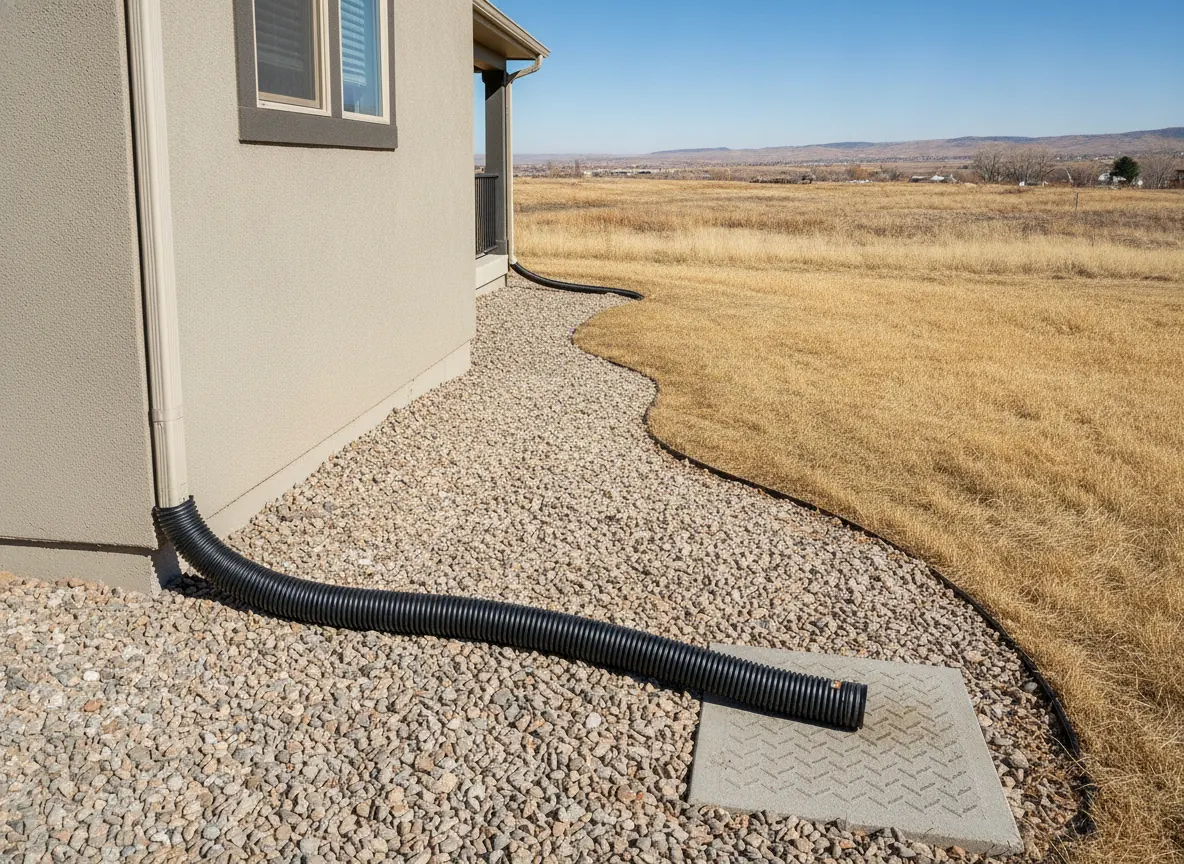
Two CGS documents supply the figures. SP-14 (1981, revised 1987): "Splashblocks should be long enough and sloped enough to carry all water well away from the foundation and beyond the backfill area. Water should be discharged no closer than 5 feet from the foundation. Usually it is necessary to add a downspout extension." The same guide gives a minimum grade of "1 percent (1 to 2 inches of vertical fall for 10 feet)" and a recommended "10 percent (12 inches of vertical fall for 10 feet)" within the first 10 feet of the house, and notes that "if there is a problem with leaves, a leaf strainer or leaf guard is a good buy."
HAZ-1996-01, written for the Colorado Springs and Pueblo area specifically, is blunter: "Proper installation and maintenance of gutter downspouts is also a common problem. Roof gutter downspouts can discharge large quantities of water into the subgrade soils. A positive slope of 5 percent in the first ten feet adjacent to foundations is typically recommended." Five percent over 10 feet is 6 inches of fall, which is also the model-code figure: the 2021 International Residential Code, adopted by reference in the 2023 Pikes Peak Regional Building Code, says in R401.3 that "the grade shall fall not fewer than 6 inches within the first 10 feet," with drains or swales where lot lines or walls make that impossible. Local PPRBD amendments to that section were not checked, so confirm with PPRBD before treating it as the local rule.
Why the monsoon and the snow season both matter
The airport normals show why "only 16 inches" is misleading. July and August alone bring 6.08 inches, about 38 percent of the year's precipitation, on 12.8 of the year's 36.8 rain days of 0.10 inch or more. The National Weather Service in Pueblo says the flash-flood events it records share "sustained (20 minutes or more), 2-3+ inch/hour rain rates," and a roof's worth of that burst arriving at the wall goes into the backfill all at once. At the other end of the year, March is the snowiest month at 5.7 inches and the airport records 159.7 nights at or below 32°F, so snowmelt soaks the same ground repeatedly through the freeze-thaw season. Both patterns reward getting water to the 5-foot line and onto falling grade.
Extensions, splash blocks and downspout count
Cost guides put downspouts at about $190 each installed for a 12-foot painted aluminum run, extensions at $2 to $17 each and splash blocks at roughly $6 to $85. The usual hardware is a hinged or rigid extension feeding a splash block, which SP-14 says should be "long enough and sloped enough" to clear the backfill zone; flip-up extensions solve the mowing problem. Count matters too: CGS's guide includes a figure for gutters longer than 35 feet, and cost guides commonly figure one downspout per roughly 35 feet of gutter, because a long run draining to one corner concentrates water where the soil can least afford it. See downspouts and drainage for sizing and the cost guide for prices.
Buried drains: not researched here
Many homeowners ask whether downspouts can be buried and run to the street or a dry well. That is a real option, and 4-inch perforated drain pipe is only about $1.28 to $1.50 per foot in material. But this site did not research Colorado Springs' rules on connecting downspouts to the storm sewer, or whether a buried downspout drain counts as plumbing that needs a state-licensed plumber, so we will not guess. Ask PPRBD and the installer before anyone digs; the CGS guidance still applies at the outlet.
Three things to check this weekend
- Walk the house right after a rain and note where each downspout actually discharges and whether water pools at the wall.
- Check the grade: a level and a tape across the first 10 feet should show roughly 6 inches of fall. Mulch beds and settled backfill often slope the wrong way.
- Note any cracks or heaving. Colorado's seller disclosure form asks about "cracks, heaving or settling problems" and "flooding or drainage," so these matter at resale too.
How this site fits in
Colorado Springs Gutter Installation connects Colorado Springs-area homeowners with independent local gutter installation, guard and repair companies for free, no-obligation quotes. We do not install anything and we are not engineers; for a foundation that is already moving, a geotechnical engineer is the right call. For the gutter side, ask each company to show downspout count, extension length and discharge points on the written quote. See seamless gutter installation and gutter guards, or request free quotes now; we usually reply the same day.
Frequently asked questions
Are downspout extensions necessary in Colorado Springs?
On expansive clay soils, yes in most cases. The Colorado Geological Survey's homeowner guide on swelling soil says downspout water "should be discharged no closer than 5 feet from the foundation" and that "usually it is necessary to add a downspout extension" to get there. A standard elbow and short splash block often discharge within two or three feet. Extensions cost about $2 to $17 each in cost guides, so ask for them in the quote.
How much should the ground slope away from a Colorado Springs foundation?
The CGS engineering-practice report for Colorado Springs says "a positive slope of 5 percent in the first ten feet adjacent to foundations is typically recommended," or 6 inches of fall. The 2021 International Residential Code adopted through the 2023 Pikes Peak Regional Building Code calls for grade to fall "not fewer than 6 inches within the first 10 feet." Local amendments to that section were not checked, so confirm with PPRBD for your lot.
Can downspouts be buried in Colorado Springs?
Buried drain lines exist, but this site did not research Colorado Springs' storm-sewer connection rules or whether a buried downspout drain counts as plumbing requiring a state-licensed plumber, so we cannot say what applies to your property. Ask PPRBD and the installer before anyone digs. Whatever the method, the CGS guidance still governs the outlet: water should leave the system at least 5 feet from the foundation, on grade that falls away.