
How Gutter Quotes and an Installation Visit Work in Colorado Springs
Colorado Springs Gutter Installation is a free quote service, not a gutter company. We connect Colorado Springs-area homeowners with independent local gutter installation, guard and repair companies for free, no-obligation quotes. Here is our part, and what a seamless gutter installation visit typically involves.
Get a Free QuoteOur part: getting you quotes
We don’t install, replace, repair or clean anything ourselves. The company you choose does the work and contracts with you directly.
You share the details
Fill out the free quote form or call. Tell us the number of stories, the approximate roof perimeter in feet (pace the sides that need gutters), the material and size you are leaning toward, whether old gutters need to come off, and what you have noticed: overflow at a corner during a storm, icicles on a north eave, a downspout dumping at the foundation, hail dents, a sagging run. If the gutters are part of a re-roof or an insurance claim, say so; the paperwork is different.
Local companies follow up
Your request goes to independent gutter companies that serve your part of the region, from Fountain and Security-Widefield to Monument and Woodland Park. We usually reply the same day. Spring and fall are the easiest time to schedule; after a major hail storm, waits across El Paso County stretch for months.
You compare
Seamless gutters are quoted by the linear foot, with downspouts, extensions, guards, removal and any fascia repair listed separately. Compare the itemized quotes against our cost guide and the checklist below.
You decide
You choose which company to hire, if any. There is no obligation, and the quotes are free.
Before you hire: what to ask for
Colorado has no state contractor license for gutters, and the Pikes Peak Regional Building Department licenses only work that requires a permit, has no gutter license class, and does not list gutters in its permit lists, so stand-alone gutter work generally needs no PPRBD permit or license (confirm with PPRBD for your project). With no license to look up, the paperwork is the check:
- Proof of liability insurance and workers’ compensation coverage, dated and in the company’s legal name.
- A written, itemized quote: material and gauge, 5- or 6-inch width, hanger type and spacing, downspout size (2x3 or 3x4) and count, extensions, drip edge or gutter apron, and removal and disposal of the old gutters.
- The manufacturer’s finish warranty and the installer’s workmanship warranty, in writing, with the terms spelled out.
- When gutters are part of a re-roof: the contractor’s PPRBD D-1 roofing license number and the permit. PPRBD requires a permit for roof work over 100 square feet and a D-1 licensed roofing contractor unless an owner-occupant does the work, plus an ice barrier above 7,000 feet.
- For hard-wired heat cable, who the electrician is; for buried downspout drains, whether any permit applies.
If the job is insurance-funded roof work, Colorado’s roofing law (SB12-038, CRS 6-22-101 to -105) requires a written contract and gives you 72 hours to cancel after a claim denial; it covers roofing contractors, and gutters are not named in it. Ask your insurer what your policy covers. This is general information, not legal advice.
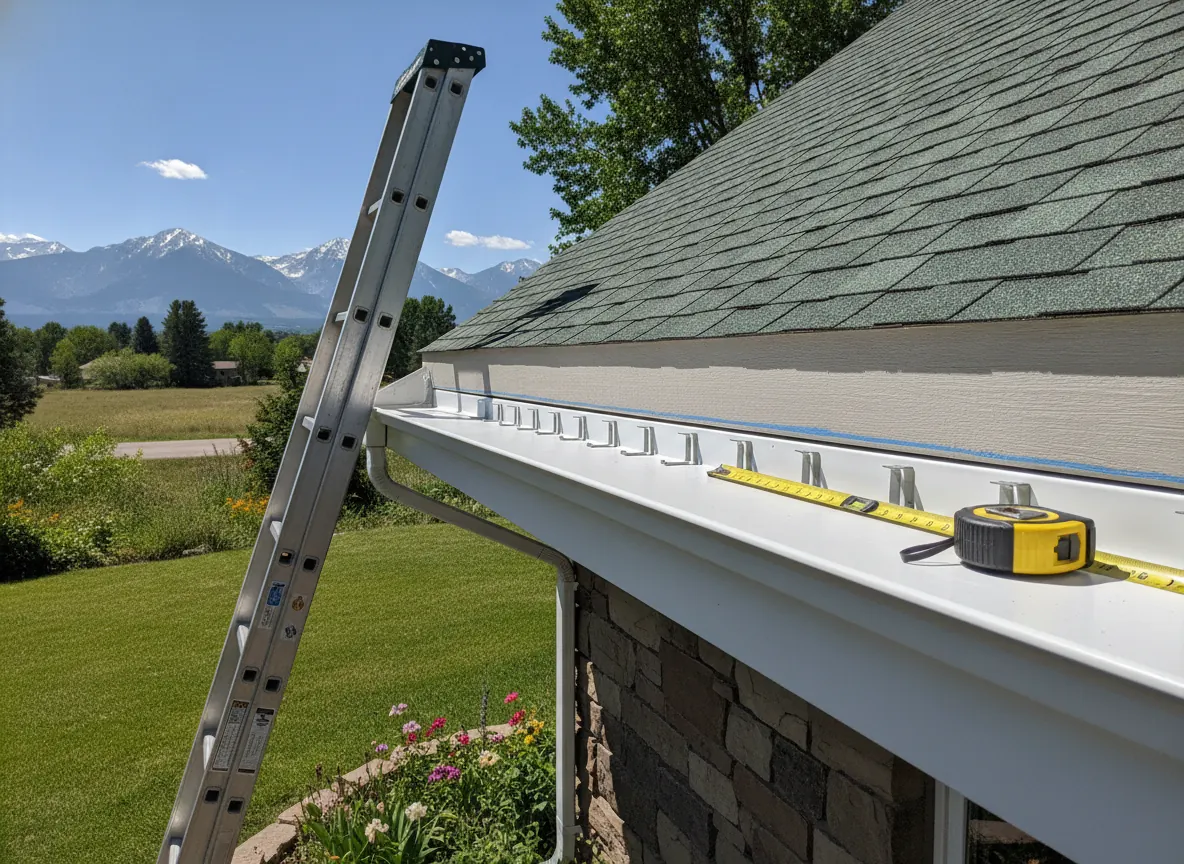
What a seamless gutter installation visit typically involves
Every company has its own routine, but a seamless install follows the same order on a 1980s Rockrimmon ranch or a 2015 Wolf Ranch two-story: measure, strip, check the wood, run out the gutter on site, hang it, connect the downspouts, clean up, hand over the paperwork. Most single-family homes take a day; two-story homes with many corners, fascia repair or guards can take two.
Measure and set the pitch
The installer measures each eave, counts corners and decides where the downspouts go, then marks a chalk line along the fascia that falls toward each outlet. The usual pitch is around a quarter inch per 10 feet, enough to drain without looking crooked from the street. Roof area and pitch decide whether 5-inch or 6-inch gutters and 2x3 or 3x4 downspouts are called for; the July–August storms here are the reason to err larger on big roofs.
Remove the old gutters
Old sectional or dented seamless gutters, spikes and hangers come off and go in the trailer. Removal and disposal is usually a separate line (about $100 plus $1.30–$2.40 per foot in published guides). If the gutters are coming off for a re-roof, this step happens before the shingles and the new gutters go on after the drip edge.
Check the fascia and drip edge
With the gutters off, the installer looks for rotted or hail-split fascia, loose soffit and missing drip edge. Soft wood is repaired or wrapped before anything is hung, because hangers screwed into rot will sag within a season. On homes in the city’s wildland-urban interface, a metal drip edge that leaves no wood exposed is part of the detail.
Run out the gutter on site
Coil stock feeds through a gutter machine in the truck and comes out as one continuous K-style profile, cut to the exact length of each eave, which is why “seamless” gutters have joints only at the corners and end caps. Corners are mitered and sealed; end caps are crimped and sealed. Color is baked into the coil, so confirm the color against your HOA’s rules before the truck arrives.
Hang it on hidden hangers
Each run is lifted, set to the chalk line and fastened with hidden hangers screwed through the fascia into the rafter tails, typically every 24 inches or closer where snow load is heavy. Steel gutters and Palmer Divide homes get tighter spacing. Outlets are cut and downspout drops attached.
Place the downspouts and extensions
Downspouts are strapped to the wall, elbowed away from the house and finished with an extension or splash block. The Colorado Geological Survey recommends discharging water no closer than 5 feet from the foundation on expansive soils, with ground sloping away, so this is the step to watch: an extension that ends at the flower bed defeats the whole system. Buried drains to daylight are an option on sloped lots.
Water-test and clean up
A hose run on the roof shows whether each run drains to its outlet without standing water and whether the corners hold. Screws, scrap and old hangers are picked up with a magnet sweep; the old gutters leave with the crew.
Warranty paperwork
You should leave with the itemized invoice, the manufacturer’s finish warranty and the installer’s workmanship warranty in writing. Keep them with your house records; Colorado’s seller disclosure form asks about known gutter or downspout problems and hail damage when you sell.
Timing in Colorado Springs
Spring and fall are the dry-ground windows. December through February are the driest months at the airport station (NOAA 1991–2020 normals) and work continues on calm days, though sealant temperature limits and snow on the roof edge can push a date. The busiest time is right after a hail storm, when gutter crews follow the roofers. If you want heat cable for the winter, ask for it in September or October rather than after the first ice dam. Read more about seamless gutter installation, or get the answers to common questions.
Hail season or snowmelt, get a clear gutter quote first.
Free, no-pressure quotes across Colorado Springs, Fountain, Monument, Falcon, Woodland Park and El Paso County.